Quick links
TL;DR (Quick Answer)
Spam traps are email addresses used by mailbox providers and anti-spam organizations to identify senders with poor list hygiene or spam-like behavior. Hitting too many spam traps can damage sender reputation, hurt deliverability, and even land your domain or IP address on a blacklist.
Most spam trap problems come from outdated lists, purchased contacts, weak signup validation, or emailing inactive subscribers for too long.
Spam traps are one of the fastest ways to damage email deliverability.
You can have strong copy, clean HTML, proper authentication, and a technically valid sending setup, but repeated spam trap hits can still push your emails into spam folders or trigger blacklist issues.
The frustrating part is that many businesses hit spam traps without realizing it.
Old databases, inactive subscribers, purchased lists, typo-filled signup forms, and poor list hygiene all create opportunities for spam trap addresses to slip into your campaigns over time.
Understanding how spam traps work makes it much easier to avoid them before they hurt your sender reputation.
Key takeaways
- Spam traps are designed to identify risky or irresponsible email sending practices
- Anti-spam organizations like Spamhaus use spam traps to detect poor list hygiene
- Purchased lists dramatically increase spam trap risk
- Recycled and typo traps are common in old or poorly maintained databases
- Falling open rates and sudden spam placement can signal a spam trap issue
- Cleaning inactive contacts and verifying email addresses helps prevent spam traps
- Recovery usually requires aggressive list cleaning and engagement-based segmentation
What is a spam trap (honeypot)?
A spam trap, sometimes called a honeypot, is an email address used to identify senders with poor email practices.
Mailbox providers, ISPs, and anti-spam organizations like Spamhaus use spam traps to detect behavior commonly associated with spam.
These addresses are not used by real people for normal communication. Their only purpose is to catch senders who collect or maintain email lists irresponsibly.
When an email reaches a spam trap, it signals that something is wrong with the sender’s list hygiene or acquisition process.
For example, spam trap hits often happen when businesses:
- Buy email lists
- Scrape addresses from websites
- Continue emailing inactive contacts for years
- Fail to clean typo-filled or outdated databases
- Skip email verification entirely
A single spam trap hit usually won’t destroy deliverability overnight, but repeated hits can seriously damage sender reputation and increase the risk of blacklisting.
Tip: Worried you hit a spam trap? Use our free blacklist checker to see if you’ve been added to a blacklist without your knowledge.
The 4 types of spam traps (and how you hit them)
Some spam traps are designed to catch outright spammers, while others target senders with poor list hygiene or outdated databases. Knowing the differences makes it easier to identify where problems may be entering your list.
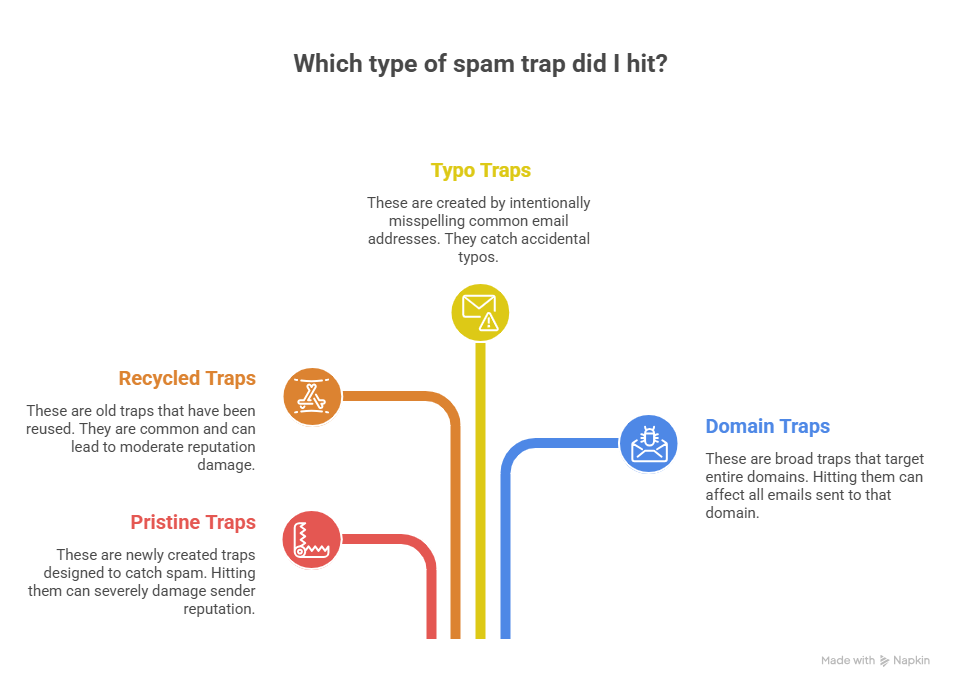
Which type of spam trap did I hit?
Pristine traps (the deadliest)
Pristine spam traps are email addresses created only to catch spam. They have never belonged to a real user and were never used for legitimate communication.
Because of that, there’s almost no legitimate reason for these addresses to appear on your list.
Pristine traps usually get collected through:
- Purchased email lists
- Scraped website data
- Leaked databases
- Questionable lead generation tactics
Hitting pristine traps is a major red flag for mailbox providers and blacklist operators because it strongly suggests the sender collected addresses without proper consent.
Recycled traps (the most common)
Recycled spam traps are old email addresses that once belonged to real users but were abandoned and later reactivated as traps by mailbox providers or anti-spam organizations. They’re extremely common in old databases.
A recycled trap usually appears when businesses continue emailing inactive subscribers for months or years without cleaning their lists. Over time, abandoned inboxes can turn into spam traps quietly in the background.
Typo traps (the accidental)
Typo traps are addresses created around common spelling mistakes in email domains.
For example:
- gamil.com
- yaho.com
- hotnail.com
These traps usually enter databases through signup typos or weak form validation.
While typo traps are less severe than pristine traps, large numbers of them still signal poor data quality and weak collection practices.
Domain traps (the broad net)
Domain traps monitor sending behavior across entire domains instead of individual addresses.
In some cases, mailbox providers or anti-spam systems watch how senders interact with inactive or abandoned domains over time. Continuously sending to invalid domains signals poor database maintenance and can damage sender reputation.
This often happens when businesses keep very old email lists without regular verification or cleanup.
Tip: Check out our guide on how to build email lists the right way to avoid collecting these traps and protect your sender reputation.
How do you know if you’ve hit a spam trap?
Spam trap problems usually show up through deliverability issues before you ever receive a direct warning.
One of the most common signs is a sudden drop in open rates. Emails that previously performed well may start landing in Spam folders or disappearing from inboxes entirely.
You may also notice:
- Rising bounce rates
- Lower click-through rates
- Unexpected blacklist alerts
- Campaigns reaching fewer subscribers than normal
- Gmail or Outlook placement worsening suddenly
In more serious cases, your sending domain or IP address may appear on a blacklist maintained by organizations like Spamhaus.
The difficult part is that spam traps themselves are intentionally hidden. Mailbox providers and blacklist operators rarely tell you exactly which address triggered the problem.
How to cleanse your list and recover from a spam trap
Recovering from a spam trap issue usually requires aggressive list cleaning and a shift toward safer sending practices.
The first step is stopping sends to questionable or highly inactive segments immediately. Continuing to email a damaged list can make deliverability problems worse very quickly.
From there, focus on engagement-based cleanup:
- Remove subscribers who haven’t opened or clicked in several months
- Suppress hard bounces and invalid addresses
- Pause sending to old imported databases
- Eliminate purchased or scraped contacts completely
Running the remaining active list through an email verification tool is also important. Verification identifies invalid, disposable, typo-filled, and risky addresses before they trigger additional spam trap hits.
To get started on cleaning your email list and getting your email health back up to par, sign up for EmailListVerify’s free trial.
[Verify 100 emails free]
If your domain or IP address has already been blacklisted, you may also need to request delisting after cleaning the database and improving sending practices.
Recovery can take time, especially if sender reputation has been heavily damaged, but consistent list hygiene and engagement-focused sending usually improve deliverability gradually.
Spam trap severity matrix
Different spam traps point to different underlying list problems.
Some indicate serious acquisition issues, while others are more commonly tied to poor list hygiene, weak validation, or neglected databases.
The table below breaks down the most common spam trap types, how they usually enter a mailing list, and how to reduce the risk.
| Trap type | How it gets on your list | Danger level | Solution |
| Pristine trap | Purchased lists, scraping, leaked databases | High | Stop using non-permission-based lists and remove questionable contacts immediately |
| Recycled trap | Old inactive subscribers left on the list too long | High | Clean inactive subscribers regularly and enforce a sunset policy |
| Typo trap | Signup mistakes and weak form validation | Medium | Use real-time email verification and confirmation emails |
| Domain trap | Sending to abandoned or invalid domains repeatedly | Medium | Verify older databases and suppress invalid domains |
Pristine traps are usually the most damaging because they strongly suggest the sender acquired contacts without proper consent. Hitting recycled traps often points to neglected list hygiene and inactive subscribers that were never removed.
Typo and domain traps are generally easier to prevent with better signup validation, regular list cleaning, and confirmation workflows like double opt-in.
The important thing is that spam traps are rarely random. In most cases, they expose weaknesses in list acquisition, subscriber management, or database maintenance.
Conclusion
Spam traps are designed to identify senders with poor list hygiene, risky acquisition practices, or outdated databases.
In many cases, businesses hit them accidentally through years of inactive subscribers, weak signup validation, or neglected email lists. The longer those problems go unchecked, the more deliverability damage they can cause.
The good news is that spam trap issues are usually preventable.
Regular list cleaning, engagement-based segmentation, sunset policies, and email verification all help keep risky addresses out of your campaigns before they affect sender reputation.
Healthy deliverability starts with healthy data. The cleaner your list is, the easier it becomes to consistently reach real inboxes instead of Spam folders.
Join Our Monthly Newsletter
Learn how to improve email deliverability and clean your email lists with and more.